
Despite the beast from the east some soft fruits have been amazing this year. The strawberries really benefitted from the cold winter and the damp spring. This has given them an amazing flavour and colour. Sadly, the raspberries have not enjoyed this weather so much and are suffering. We hope they will pick up and we can still enjoy some later this month. Fresh is always best when making homemade jam.

So, this week Steve and I took a tip to Oxford Farm just south of Berwick. We have been picking strawberries and raspberries here for the last 5 years for serving at breakfast and for jam.

An hour of picking we came home with five kilos of lush, juicy strawberries. We also had sore backs but it’s always worth it.

After a quick wash, three kilos went into the jam pan with three kilos of caster sugar and the juice of two lemons. Forty minutes of boiling down and they are in jars waiting to cool. The next morning and the guests are enjoying fresh homemade jam on their toast.

As you may have guessed we make all our jams and marmalades here at Market Cross. Why would we buy jam when we can make it so easily and without all the man made stuff. All we use are fruit and sugar with a bit of pectin if it refuses to set. Simple. It is also so satisfying to hear the guests enjoying them and we even sell some.

We will be going back in a few weeks to harvest the raspberries and more homemade jam will be made. Not as much as the marathon Seville orange marmalade session in January, but enough.

Any we have spare (in this case two kilos) are for breakfast as well. It’s good to add fresh local fruit as an addition to all the other good things we put out for them.
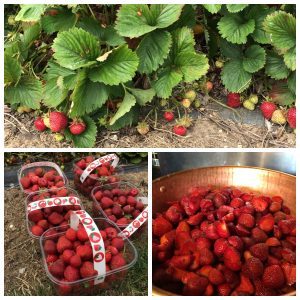
Strawberries for homemade jam

Strawberries form Oxford Farm

If you’ve never made homemade jam before it’s worth doing. You don’t need a big jam pan like ours and a little time and patience will get you a few jars. Give it a try and you won’t eat shop bought again.


It’s been mayhem in the Market Cross kitchen today, Belford has a community market every bank holiday weekend so I am busy kneading and proving my bread. I bake around 20 to 30 loaves to sell and usually a mixture of white, brown, spelt and fruit loaves. It takes a few days and is full on but I enjoy the challenge of making them. And with only one oven.

When I first arrived at Market Cross, bread was one of my many passions. Having been to Edinburgh on a course with Andrew Whitely I knew I wanted to make my own bread for the B&B. I’m really keen, as usual to use local produce wherever possible and have 2 flour producers right on my door step.  After struggling for a few months to get my bread right I decided to go on another bread course. This time it was with with Bread & Roses in Alnwick. While there I discoverd that the local flours contained higher levels of gluten than I was used to. That was why my bread was not rising!  Changed my flour and hey presto, great bread.

Variety being the spice of life I have made many different types to go with various dishes. Sour dough, focaccia, bagettes,soda and ciabatta to name but a few. It depended entirely on what dish I was preparing of course and was part of the meal plan, particularly when we were serving evening meals. I  have sometimes struggled in the winter to get it to rise (old house) and in the summer with it over proving.

Needless to say all our bread for breakfast is made by us and you can see our menus here.

Having recently met the new miller, Dave from Heatherslaw Mill near Ford and Etal, of course the conversation turned to bread, flour and all things baking.  I explained my problems with the local flour and Dave told me that it was to do with the quality of the wheat and the way it was milled.  He suggested that I try the Heatherslaw flour and I am currently using his wholemeal and malted.

Steve and I went up to the mill to collect our first batch of flour and had a guided tour. It is really fascinating and well worth a visit when your in the area.

Needless to say all the bread


https://www.ford-and-etal.co.uk/heatherslaw-mill